
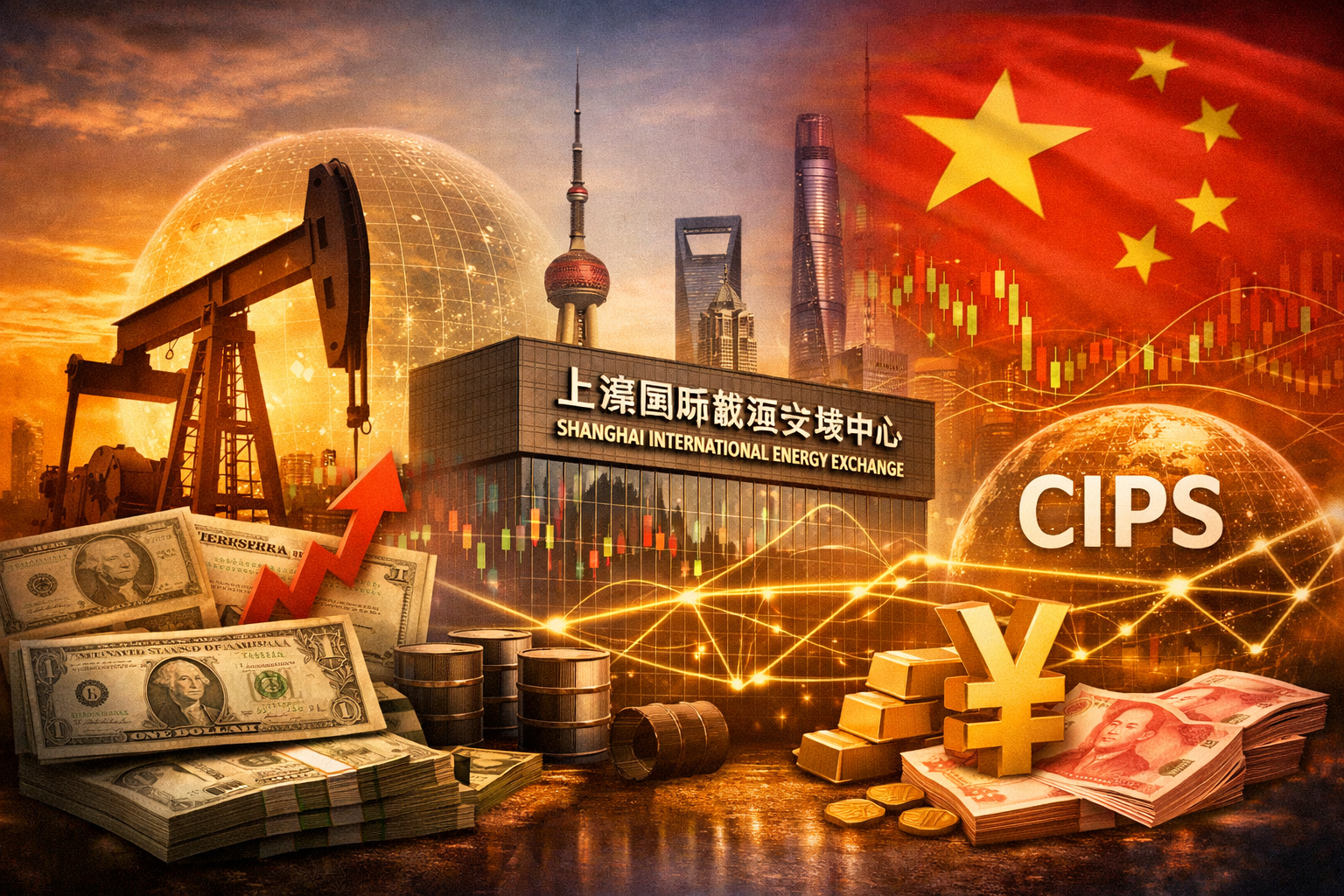
The historical supply shock created by the war in the Middle East is shaking global energy markets, bringing the future of the dollar-centric financial architecture and “petro-yuan” scenarios back to the forefront. However, China’s primary goal is not to overthrow the dollar, but to build a reliable alternative payment layer.
The impacts of the Middle East war on energy supply extend beyond a mere price story, creating profound tremors in global dollar liquidity, risk premiums, and trade finance. Disruptions in shipments through the Strait of Hormuz, which carries approximately 20% of global oil consumption, and attacks on Gulf energy infrastructure have caused an unprecedented shock in markets. As basis differences between physical markets and futures contracts widen, supply security is placing significant pressure on energy-importing countries in Asia. This crisis environment reopens the debate on the resilience of the “petrodollar” system and China’s (RMB) internationalization strategy.
Petrodollar: Why is it Shaking, Why Hasn’t it Collapsed?
The petrodollar system, built on dollar-denominated invoicing of energy trade, a dollar payment infrastructure, and a reserve recycling mechanism based on US Treasury bonds, has undergone serious tests in recent years. Sanction risks, the politicization of reserves, and geopolitical bloc formation, coupled with the crisis triggered in the Middle East, are among the main factors challenging this structure. Despite this, the dollar’s dominance has not been broken. The fundamental reasons for this are the deep and liquid US Treasury market, a robust legal framework, advanced repo and hedge instruments, and the “network” effect created by the reserve currency. For energy-exporting countries, the dollar still remains the safest and most liquid haven.
System Evolution: Regime Collapse or Transition to a Multipolar Structure?
The current energy-finance tension, triggered by Middle East-sourced supply shocks, in many ways recalls the period after the collapse of the Bretton Woods System in the 1970s. At that time, oil crises, combined with the dollar’s detachment from gold, triggered a forced restructuring of the global monetary system. Today, similarly, the US’s actions, which disregard its allies and international diplomacy, along with disruptions in energy supply, the effects of sanctions on the financial system, and the politicization of reserves, are leading to questions about the dollar-centric petrodollar architecture. However, the critical difference is that today’s system no longer relies on a single anchor like gold, but on the depth, liquidity, and risk management tools of US financial markets. Therefore, the ongoing process should be interpreted not as a regime collapse, but as an evolution towards a multipolar and layered monetary system.
China’s Changing External Asset Composition
China’s reserve management strategy is not a direct exit from the dollar, but rather a repricing of risk and diversification of its portfolio. The $623 billion reduction in Treasury bond holdings over the past thirteen years has been distributed across specific investment categories.

Sources: U.S. Treasury TIC Data, Ginnie Mae (Agency MBS), World Gold Council, SAFE, IMF COFER
China’s US Treasury bond holdings, which peaked at $1.317 trillion in 2013, have fallen to approximately $694.4 billion as of January 2026, with these resources redirected to different asset classes. The most striking increase during this period has been in gold reserves: holdings rose from 1,054 tons in 2010 to 1,948 tons in 2020, and further to 2,309 tons as of February 2026. The dollar value of gold reserves also increased from approximately $40 billion to a range of $200–220 billion during the same period. In addition, there has been an increased shift towards other dollar assets such as corporate bonds, deposits, and offshore custody accounts, as well as alternative currencies like the Euro, Yen, and SDR. This diversification strategy indicates that China is not abandoning the dollar entirely, but rather directing its portfolio towards more liquid, secure, and geopolitically protected assets.
Shanghai Exchange and the Petro-Yuan Reality
One reflection of the multipolar system is the “petro-yuan” initiative, centered around the Shanghai International Energy Exchange (INE). Launched in 2018, RMB-denominated crude oil contracts have gained significant depth by integrating directly into China’s import market with their physical delivery feature. The market is expanding with the participation of national giants like Sinopec and PetroChina, as well as global traders like Vitol and Trafigura, increasing the use of RMB-based settlement, especially in flows originating from Russia and, to some extent, Iran. However, the fact that INE prices have not yet become a global benchmark like Brent or Dubai indicates the market’s structural limitations, such as limited convertibility, hedge instruments, and reserve recycling capacity. Therefore, at the current stage, the petro-yuan is positioned not as a system replacing the petrodollar, but as an increasingly strong alternative pricing and payment layer in specific trade corridors.
The Shanghai exchange prices reflect the price of physical oil entering China rather than a global financial benchmark in the classical sense. Therefore, the petro-yuan discussion is less about currency competition and more about the reshaping of physical energy trade corridors. The expansion of RMB pricing and payment options creates an alternative financial channel that can facilitate access to Middle East oil for Asian economies. The opening of RMB-based settlement corridors in Gulf-Asia energy trade, the deepening of offshore RMB liquidity pools, and the development of RMB trade finance products specifically for oil and LNG trade are the fundamental building blocks of this transformation. However, the sustainability of this system depends not only on the payment stage but also on the development of investment instruments, free convertibility options, and liquid markets where producing countries can effectively utilize the RMB they acquire.
Global Limits and Conclusion
The rise of the RMB is not progressing in a linear fashion. China’s internal economic dynamics and capital controls create a limit in terms of international trust. Replacing the dollar and gaining a share in specific trade corridors are different goals. The financial power of the US stems not only from its currency but also from its legal system, market depth, and investor base.
Although war has accelerated supply shocks and “de-dollarization” discussions, the dollar order will not collapse overnight. The real opportunity for China is not to overthrow the petrodollar, but to build a reliable, liquid, and hedgeable second channel for the RMB in energy trade. This path requires establishing an open and predictable financial infrastructure.
Leave a Reply