
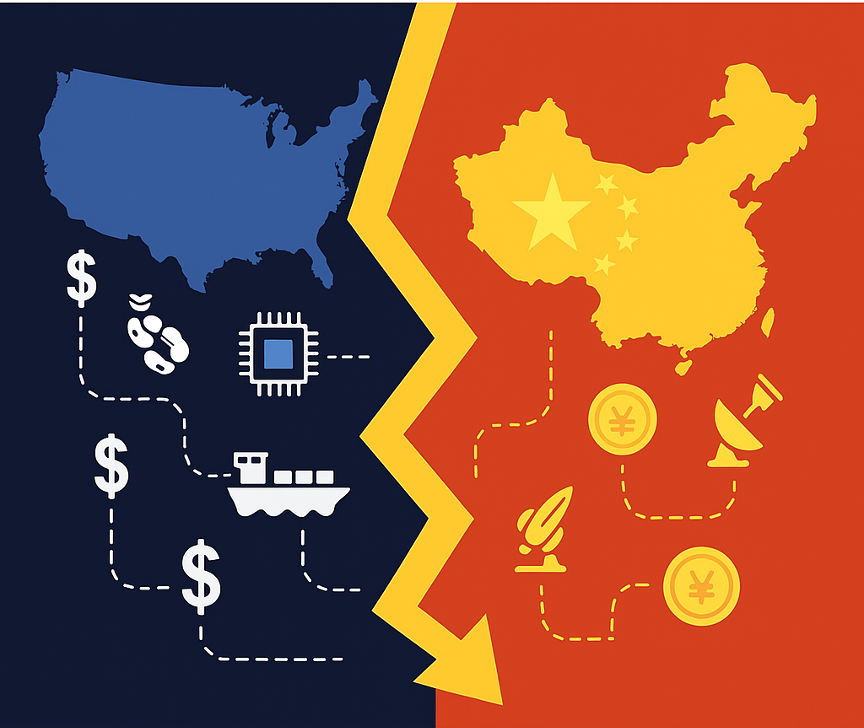
The escalating US-China trade war has reached a critical juncture, with both nations imposing retaliatory tariffs exceeding 100% on key imports. As Washington and Beijing dig in, China is accelerating its shift toward self-sufficiency and alternative trade and monetary systems—a move that could redefine global economic alliances. China’s push for alternatives isn’t new, but it directly challenges the “exorbitant privilege” of the USD-based monetary system, which has long underpinned global trade. Below is a breakdown of the current landscape and what’s next:
1. The Tariff War: By the Numbers
– China’s Retaliation: An additional 50%+ tariff put on all US imports reached a total of now 125%, targeting soybeans, semiconductors, and energy products such as LPG/LNG. Beijing has stated it will “ignore” further US tariff hikes, as American goods are already priced out of the Chinese market.
– US Response: Tariffs on Chinese goods raised to 145%, with a 90-day ‘pause’ for other effected nations and further exempting Chinese exports of smart phones, computers, and other certain electronic products, as US companies like Apple is highly effected.
– Immediate Impact:
– Agricultural Trade Collapse: US soybean exports to China (21% market share) face substitution by Brazilian suppliers.
– Tech Decoupling: China’s $11.8B semiconductor imports from the US now can be diverted to Japan/South Korea.
– Energy Shifts: US propane exports to China (more than 50% of China’s imports) may plummet, forcing reliance on the Middle Eastern suppliers.

Source: Caixin/Galaxy Securities
2. China’s Counterplay: Building Parallel Systems
– Monetary Pivot and the Rise of Alternatives What It Means: From Seniorage to Settlement Sovereignty
For decades, China used its trade surpluses to buy U.S. Treasuries, indirectly financing U.S. deficits. This ‘dollar recycling‘ system is now slowly being phased out. China is increasingly using its foreign reserves for:
– Bilateral RMB-based settlements: Through SWAP lines with counterparty Central banks.
– Gold accumulation: Reserves up 63% since 2022 (Int. Investment Position of China-SAFE).
– Sovereign digital currency pilots: CBDC, e-CNY and mBridge.
– Investing in regional trade infrastructures
Because of its diversification strategy, China’s holding of the foreign currency assets in its total portfolio has been decreased from 66% in 2004 to 32% in 2024, and direct investments increased from 6% to 31% replacing the dominance of FC holdings.


China is phasing out its role in financing US deficits by reducing Treasury holdings (from $1.3T in 2013 to $775B in 2024) the lowest since 2009 and reallocating reserves.
Source: China’s IIP – PBOC, Safe
Previously, U.S. deficits were sustained by foreign buyers (like China) purchasing Treasuries with trade surpluses. This enabled ‘seniorage‘—exchanging printed dollars for real goods. But the rise of RMB-denominated trade, CBDCs, and BRICS cooperation threatens this model.
If global trade flows increasingly avoid the dollar, the U.S. may face:
– Higher borrowing costs
– Reduced global influence in capital markets
– Shift in trade finance architecture
China is also pushing the de-dollarization through BRICS+ and Commodity Alliances. BRICS members (now expanded to 10 nations) are increasing local currency trade, with China backing commodity-backed exchange mechanisms.
China is also working with the BIS Innovation Hub, Hong Kong, Thailand, UAE, and now Saudi Arabia on mBridge—a cross-border CBDC platform aiming to lower transaction costs and time while reducing reliance on SWIFT. While early figures remain unverified, the strategic intent is clear: China is building a parallel payment architecture.
3. Conclusion
The U.S.-China trade confrontation has transcended tariffs—what we are witnessing is a deeper structural shift in global finance, supply chains, and monetary sovereignty. China’s response is not reactive, but strategic: through the development of CBDCs, bilateral trade agreements, and reserve diversification, it is laying the groundwork for a trade ecosystem less reliant on the U.S. dollar.
China is no longer just adapting to the current system—it is actively reshaping it. By aligning industrial policies (e.g., semiconductor subsidies), digital finance initiatives and geopolitical frameworks like BRICS+, Beijing is positioning itself at the center of a new, multipolar trade and monetary architecture.
4. What’s Next?
– Short-Term: Volatility in energy/agricultural markets; US exporters scramble for new buyers (Europe/Latin America).
– Mid-Term: China’s domestic semiconductor/agricultural output rises; CBDC adoption accelerates in Global South.
– Long-Term: A bifurcated trade system emerges—US-centric vs. China-led blocs—with competing tech/currency standards.
.
Leave a Reply